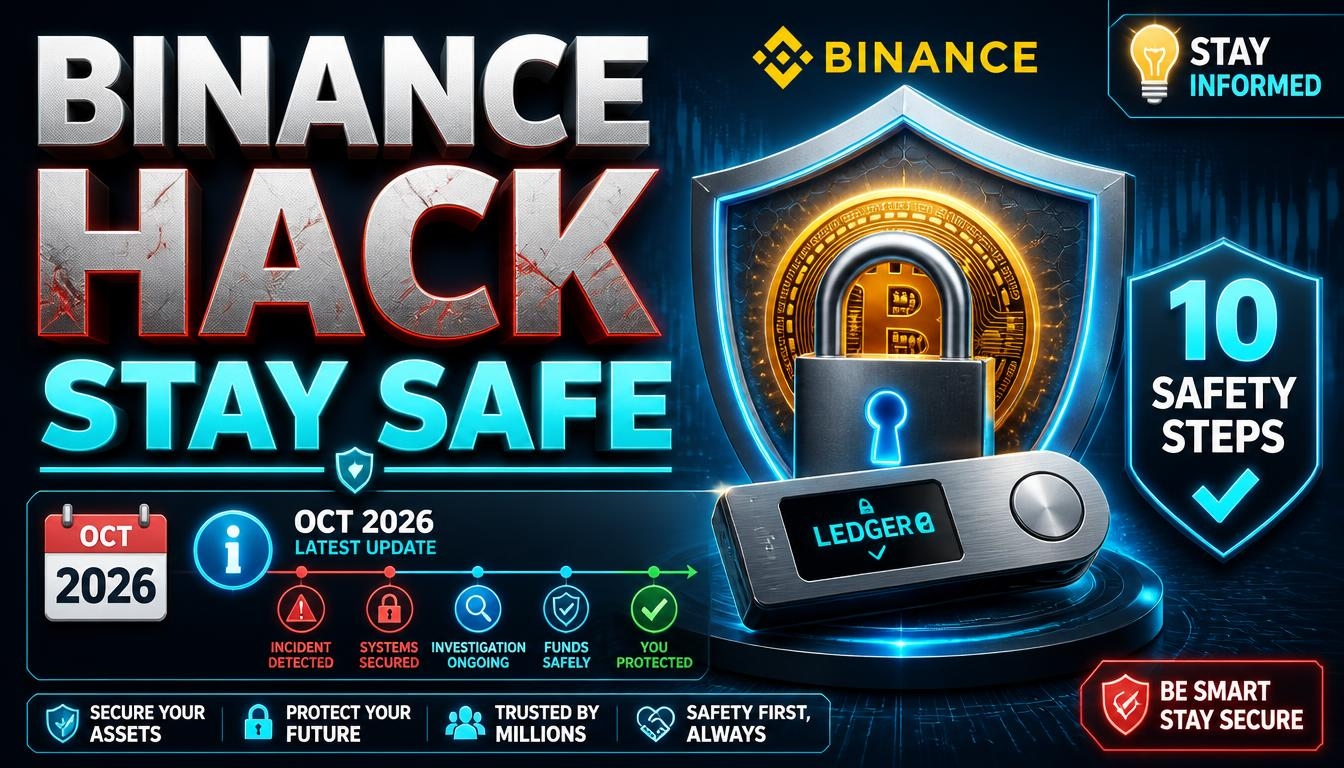
Binance Hack 2026: What Happened and How to Stay Safe
Written on November 2, 2026. The investigation is still ongoing and details may change, so check official updates before acting on anything here.
In late October 2026, Binance, one of the largest crypto exchanges in the world, reported a security incident that blockchain analysts described as the biggest crypto theft on record. If you use an exchange, or plan to, there are practical lessons in it. This article explains what has been reported, what is still unknown, and what you can do to protect your own funds.
What has been reported
According to the blockchain analytics firm TRM Labs, an attacker moved roughly $6.36 billion out of Binance wallets across ten blockchains on October 29, most of it within about 20 minutes. TRM described it as about four times larger than the Bybit theft of February 2025, which had been the biggest on record.
Binance said it will cover all losses. It also said user deposits were not affected, paused withdrawals while it investigated, and worked with partners to freeze a large share of the stolen assets, with its estimate of frozen funds rising from about $3 billion to about $5 billion. Binance’s leadership confirmed that one of the exchange’s hot wallets was affected. A hot wallet is the connected wallet an exchange uses to process everyday withdrawals.
Binance said its first findings pointed to a compromised laptop, and that further investigation found additional points of breach.
Who is thought to be responsible
TRM Labs and Chainalysis pointed to TraderTraitor, a hacking group linked to North Korea, citing similarities with earlier attacks, and US media reported that the FBI later attributed the attack to North Korea. Details can change as investigators learn more, but the attribution suggests a patient, well-resourced attacker rather than an opportunist.
What is still unclear
Exactly how the attackers got in has not been fully explained, and neither has the final amount that will be recovered or frozen. Be sceptical of any website or social media account that claims to know more than the official updates.
What it means for you
Three points are worth taking away.
- An exchange holds your crypto for you. Whatever protection it has, you are trusting a company and its systems. Even large platforms with big security budgets can be breached.
- Losses and access are different things. A company can promise to cover losses while customers still cannot withdraw for a while. Having all your money in one place means one problem can lock you out.
- Scammers follow the news. Every big hack is followed by fake compensation forms, support impersonators and phishing emails.
You do not need to rush. Moving funds in a panic leads to mistakes such as sending coins to a wrong address or falling for a fake site. Work through these steps calmly.
Ten steps to protect your crypto
- Do not keep everything in one place. Spread funds between an exchange, a wallet you control and, if it suits you, a second platform.
- Move long-term holdings to self-custody. A hardware wallet keeps your keys offline. Buy it from the maker directly, and write your recovery phrase on paper, never in a photo or a note on your phone.
- Use strong two-factor authentication. An authenticator app or a hardware security key is much safer than SMS codes.
- Use a unique password. A password manager makes this easy. Never reuse a password from another site.
- Turn on withdrawal protections. Use address whitelisting and any withdrawal delay or confirmation the exchange offers.
- Set an anti-phishing code, if the exchange offers one, so genuine emails carry a phrase only you know.
- Stick to official channels. Bookmark the real address and read updates only there. Support staff will never ask for your recovery phrase or your password, or ask you to install software.
- Treat news-driven messages as suspect. Fake compensation claims, “account recovery” forms and urgent warnings are common after incidents.
- Review connected apps and API keys. Delete the ones you no longer use. Where an app needs access, use read-only keys and limit them to specific IP addresses where possible.
- Look after the device. Keep your system and browser up to date, avoid pirated software and be careful with browser extensions. One compromised device can undo every other precaution.
A note on trust and solvency
After an incident, people often ask whether an exchange is solvent. Some analysts have said this breach does not currently look like a serious solvency threat, but that is an opinion based on partial information. Treat claims on either side with care, and judge an exchange by how it communicates and whether you can withdraw.
This is general information, not financial advice. If you are choosing where to keep your crypto, see our Crypto Exchanges category. Rankings combine visitors measured by our tracking pixel, outbound clicks from our users, member upvotes and member reviews, which shows interest and community feedback, not safety or solvency. We list exchanges but do not endorse any of them.