
Spending money on ads is easy. Knowing whether it worked is the hard part. Many first-time advertisers put a large amount into one network, wait, and then cannot tell whether poor results came from the offer, the page or the traffic.
A small, structured test fixes that. It costs little, and it tells you which networks are worth more of your money. Here is how to run one.
Know what each format is good for
- Display and banner ads. Good for awareness and retargeting, usually weaker for direct sales.
- Native ads. Ads that match the look of the page around them. They suit content such as articles and guides.
- Push notifications. Short messages sent to people who opted in. Fast and cheap, but attention is brief.
- Pop and redirect ads. Very cheap and very broad, with many accidental clicks. Useful for some offers, poor for most others.
- Search and social ads. Reach people who are already looking or browsing with intent, usually at a higher cost.
Choose the format that fits your offer. A complex product rarely sells from a pop-up.
Set a goal you can measure
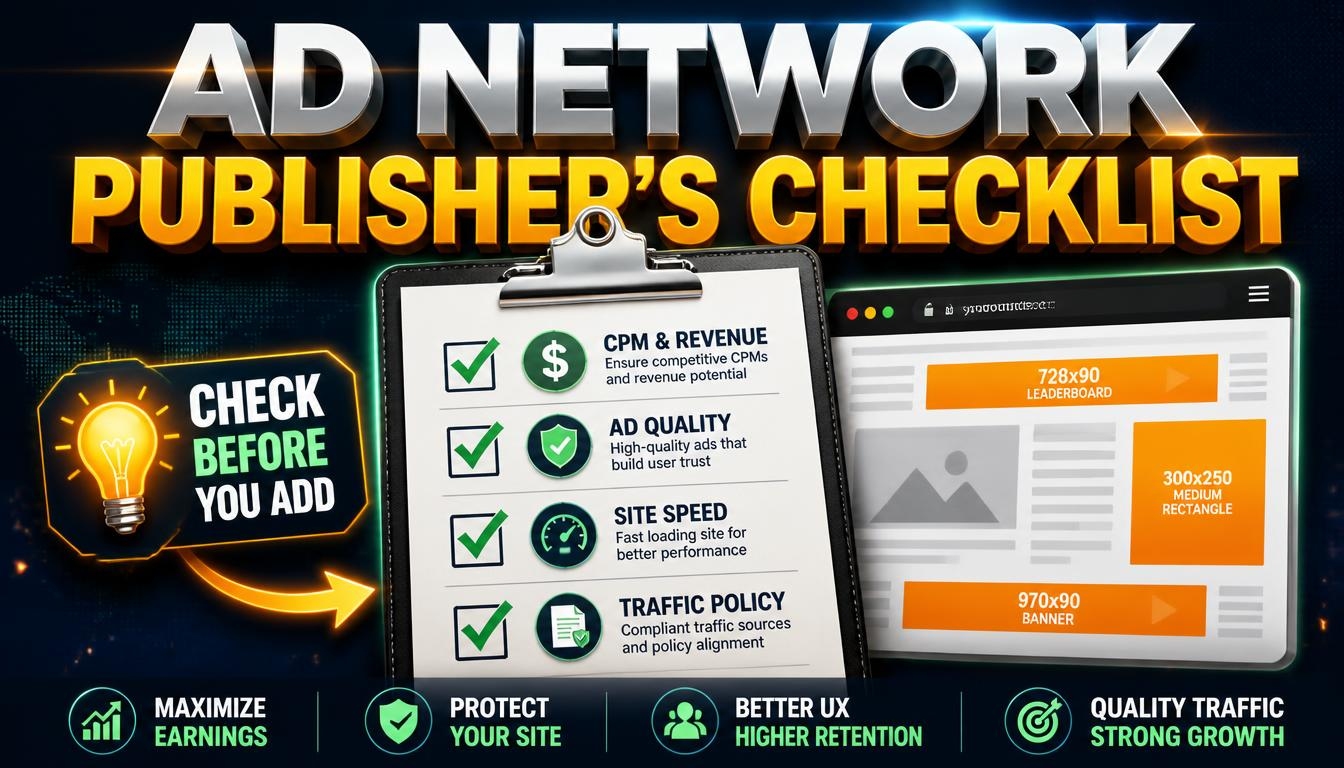
Decide before you spend what counts as a result: a sign-up, a purchase, a click on one button. Put tracking in place first, using a conversion pixel or a tracking link with campaign tags, so each network is identified separately. If you cannot tell which network sent a visitor, you cannot judge it.
Build a simple test plan
- Pick two or three networks that allow your type of offer.
- Give each the same small budget, the same page and the same targeting.
- Run the test long enough to collect real data, usually at least a week.
- Compare cost per result, not cost per click.
- Change one thing at a time, such as the headline or the image, so you know what made the difference.
Do not read too much into a handful of clicks. Wait until each network has delivered enough traffic for a pattern to appear.
Watch the traffic quality
Cheap traffic is cheap for a reason. Check how long visitors stay, how many leave at once and whether sessions come from the countries you chose. A sudden spike of identical visits can point to bots or accidental clicks. Ask each network which sources it uses and whether it can exclude a source that performs badly. Networks that cannot or will not answer are risky.
Read the money terms
Most networks want a prepaid balance. Check the minimum deposit, whether deposits are refundable, whether unused balances expire and which payment methods are accepted. Start with the smallest deposit that lets you run a real test. A network that makes it easy to add money and hard to withdraw it deserves caution.
Test your landing page too
Sometimes the network is fine and the page is the problem. Make sure it loads quickly on a phone, states the offer in a sentence and asks for one action. A good page makes every network look better.
Scale gradually
When one network produces results you can afford, raise the budget in steps and watch whether the cost per result holds. Results often change as you spend more, because the network reaches further into its audience. Keep the cheaper tests running so you always have a comparison.
Red flags
- Guaranteed conversions or sales.
- Prices far below every other network, with no explanation.
- No reporting that breaks results down by source or placement.
- No way to block a source that performs badly.
- Pressure to deposit a large amount to “unlock” better traffic.
If you are looking for networks to try, browse our Ad Networks category. Rankings combine visitors measured by our tracking pixel, outbound clicks from our users, member upvotes and member reviews. A green Verified badge means the owner installed the pixel, while No pixel means the traffic is unmeasured. We list networks but do not endorse them, so start with a small deposit and judge each one by your own results.