Most people pick a traffic exchange the way they pick a café in an unfamiliar town: by whatever looks busiest. A week later they have a stack of credits, a bounce rate near 100%, and no idea whether any of the visits were real.
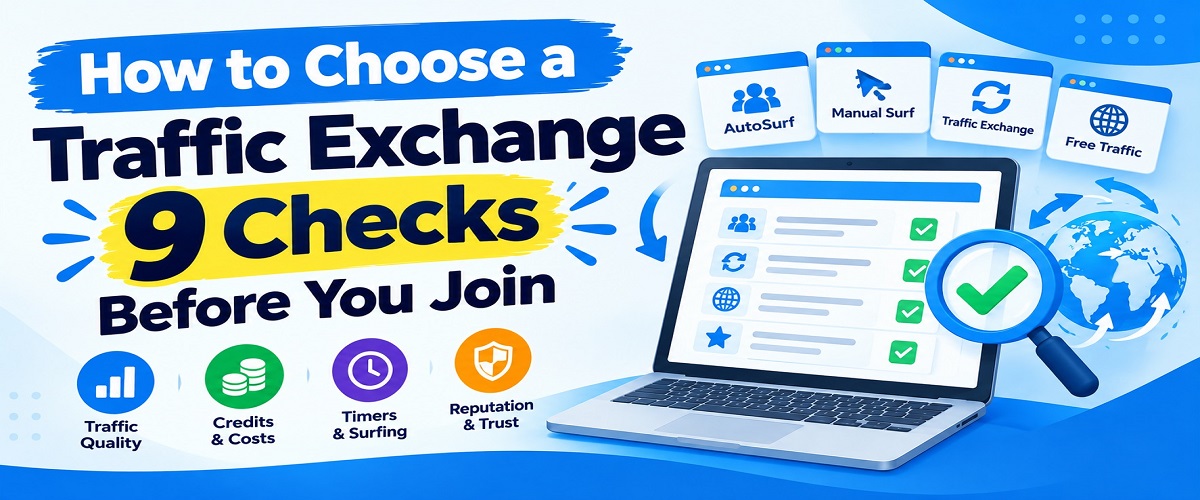
There is no perfect exchange, but there are good habits. These nine checks take about an hour in total and can save you weeks of guessing.
1. Know what kind of traffic you are getting
Manual surfing means a person opens your page and waits out a timer. Autosurf rotates pages automatically, often with nobody watching. Neither is a shopping crowd. The viewers are other members earning credits, so choose by goal: autosurf is fine for testing how your page handles load, while manual surf at least gives a human a chance to read your headline.
2. Read the timer and viewing rules
A timer of a few seconds means your page barely finishes loading before it is gone. Look for exchanges that set a sensible minimum view time, and check whether your page is shown inside a frame, because some sites break when framed.
3. Ask how they handle bots
Every exchange fights cheating. The honest ones say how: limits per account, detection, suspensions. A site that claims “100% human traffic” without explaining anything is selling a slogan. Send support a plain question about how they verify members and see whether you get a real answer.
4. Do the credit math
Find out how many credits a view costs, how many you earn for surfing, and whether credits expire. If the only way to get decent exposure is to buy a paid plan, you are not looking at a free exchange; you are looking at an ad network with extra steps.
5. Check targeting
Country and language filters matter if your offer is not global. An exchange with no targeting at all will send you a random mix, and a page in English shown to people who do not read it is wasted credits.
6. Read the content rules
Most exchanges restrict what you can promote: adult content, automatic redirects, pop-ups, some affiliate links. Read the terms before you load credits, not after your site is suspended.
7. Look at the track record
Check how long the site has existed, whether support actually replies, and what members say outside the site’s own pages. Be wary of constant rebrands. Where an exchange publishes statistics, ask whether anyone verifies them. On LA Rank, owners can add our free tracking pixel, and listings that do carry a green Verified badge and a rank based on visitors we measured rather than numbers they reported.
8. Run a small, measured test
Build one simple landing page with analytics and send a modest batch of traffic. Write down visits, average time on page, bounce rate and any action taken. Then compare your analytics with what the exchange says it delivered. A big gap tells you something important before you spend any money.
9. Start free and upgrade last
Hold off on upgrades and long prepaid plans until your test shows a result you can use. If you do pay, start with the smallest option and keep notes so you can compare it with the free tier.
What a good result looks like.
For most promoters, a good result is modest: steady visits, a handful of sign-ups from people who are interested in what you offer, and numbers that match your own analytics. If an exchange cannot give you that, move on.
Ready to compare? Browse the [[Traffic Exchanges category]] on LA Rank, where sites with our pixel are ranked by measured visitors and sites without it are clearly marked. We list sites but do not endorse them, so run your own small test first.