Long-Tail Keywords: The Overlooked SEO Strategy That Actually Works for Smaller Websites
If you've been trying to rank your website for broad, high-volume keywords — "running shoes," "email marketing," "digital marketing tips" — you've probably noticed that nothing is happening.
Here's why: you're competing with websites that have been publishing on those topics for a decade, have thousands of backlinks, and have domain authority scores you can't match in the short term.
The good news is there's a strategy that genuinely works for newer and smaller websites — and most people underuse it.
What Are Long-Tail Keywords?
Long-tail keywords are specific, multi-word phrases that target a narrower topic than broad "head" keywords.
Head keyword: "running shoes" Long-tail: "best running shoes for wide feet under $100"
Head keyword: "email marketing" Long-tail: "how to write email subject lines for B2B software"
The differences:
| Factor | Head Keywords | Long-Tail Keywords |
|---|---|---|
| Monthly search volume | High (10K–1M+) | Lower (100–2,000) |
| Competition | Extremely high | Low to moderate |
| Search intent | Vague | Specific |
| Ranking difficulty | Very hard for new sites | Achievable |
| Conversion rate | Low | High |
Why Long-Tail Keywords Convert Better
Someone searching "running shoes" is at the very beginning of a journey. They might be curious, browsing, or just starting to think about buying. They're months away from a decision.
Someone searching "best waterproof trail running shoes for wide feet under $120" has done their research, knows what they want, and is close to buying. They find your specific article — you answer their exact question — they convert.
Long-tail traffic is intentional traffic. The people arriving know exactly what they're looking for.
How to Find Long-Tail Keyword Opportunities
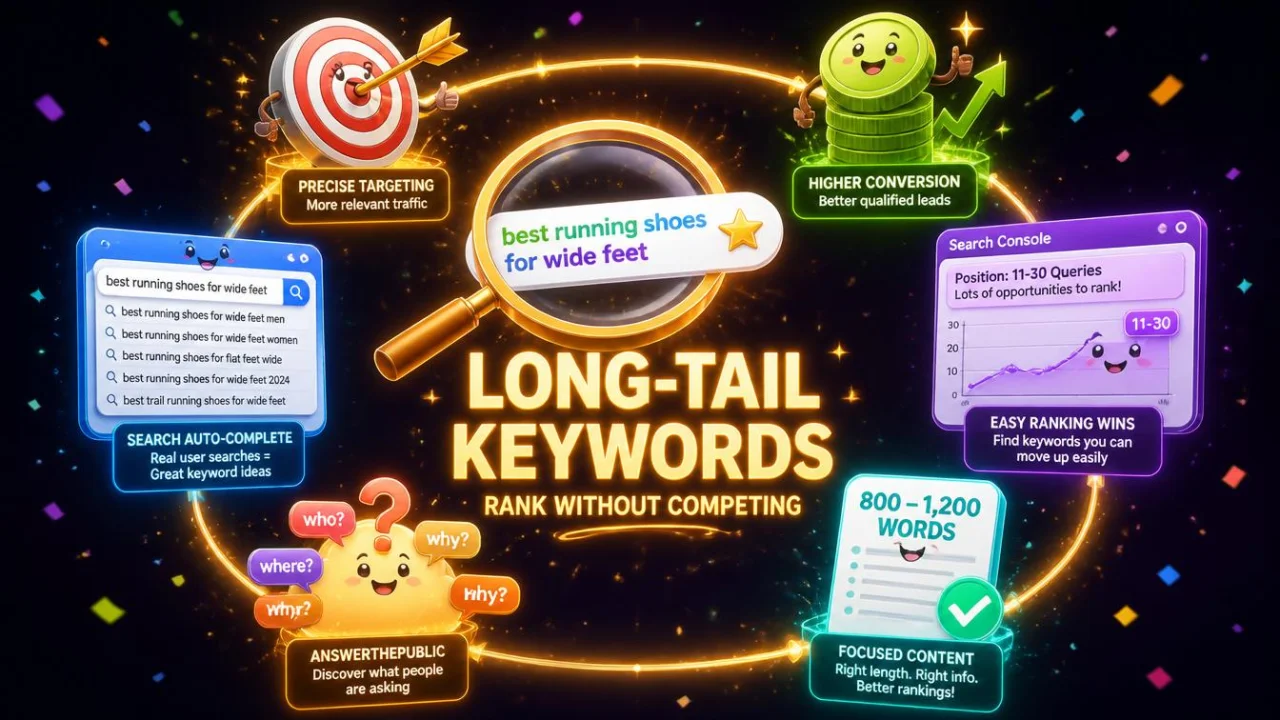
Method 1: Google's own suggestions Type any broad keyword into Google and look at the auto-complete suggestions. These are real searches people are typing. The longer, more specific ones are your long-tail opportunities.
Also scroll to the bottom of the search results page — the "related searches" section shows 8 more long-tail variations.
Method 2: Google Search Console This is a goldmine most people overlook. Go to Search Console → Search Results → Queries. Filter by pages you're already ranking in positions 11–30. These are terms Google is already serving you for — you just need a more focused article to move from page 2 to page 1.
Method 3: Answer the Public (answerthepublic.com) Free tool that generates question-based long-tail keywords around any topic. Enter your broad topic and get "who," "what," "where," "when," "why," and "how" variations. Each one is a potential blog post.
Method 4: Reddit and Quora Real people asking real specific questions. The most upvoted questions in relevant communities are telling you what your audience desperately wants answered — often in more specific terms than any keyword tool captures.
How to Structure Long-Tail Content
A long-tail article doesn't need to be exhaustive — it needs to be precisely relevant. 800–1,200 words that completely answer one specific question outperforms a 3,000-word generalist piece every time for long-tail terms.
Structure:
- Confirm you're answering the exact question immediately — within the first paragraph
- Give the direct answer early — don't make them scroll to find it
- Support the answer with detail — context, comparisons, examples
- Link to related content — help them explore the broader topic on your site
- Close with a clear next step — what should they do with this information?
Building Momentum with Long-Tail
The compounding effect of long-tail strategy is powerful: each article you publish targets a different specific query. Over 6–12 months, you accumulate dozens of pages each ranking for their own specific terms. Collectively, they drive significant organic traffic even though no individual article is targeting a high-volume keyword.
Combine this with genuine early engagement from a community like LiveAdvertise — which establishes real visit data on new articles before organic rankings build — and you create a sustainable cycle of content building on itself.
Start narrow. Go specific. Build the habit of publishing consistently. The organic traffic compounds over time.