Building a Content Calendar That Consistently Attracts Visitors (Without Burning Out)
Most content calendars fail for the same reason most New Year's resolutions fail: they're built around ambition rather than sustainability.
"We'll publish four times per week!" Then week three hits, life gets busy, and the calendar goes dark for six weeks. Google notices. Rankings drop. And you're back to square one.
Here's how to build a content calendar that actually keeps working.
The Consistency Principle
Search engines favour consistent publishers over sporadic ones. A website that publishes one well-written article per week for a year outperforms a website that publishes 20 articles in January and nothing for the next 11 months.
This is because consistency tells Google's crawlers something valuable: this site is actively maintained, regularly updated, and likely to be relevant.
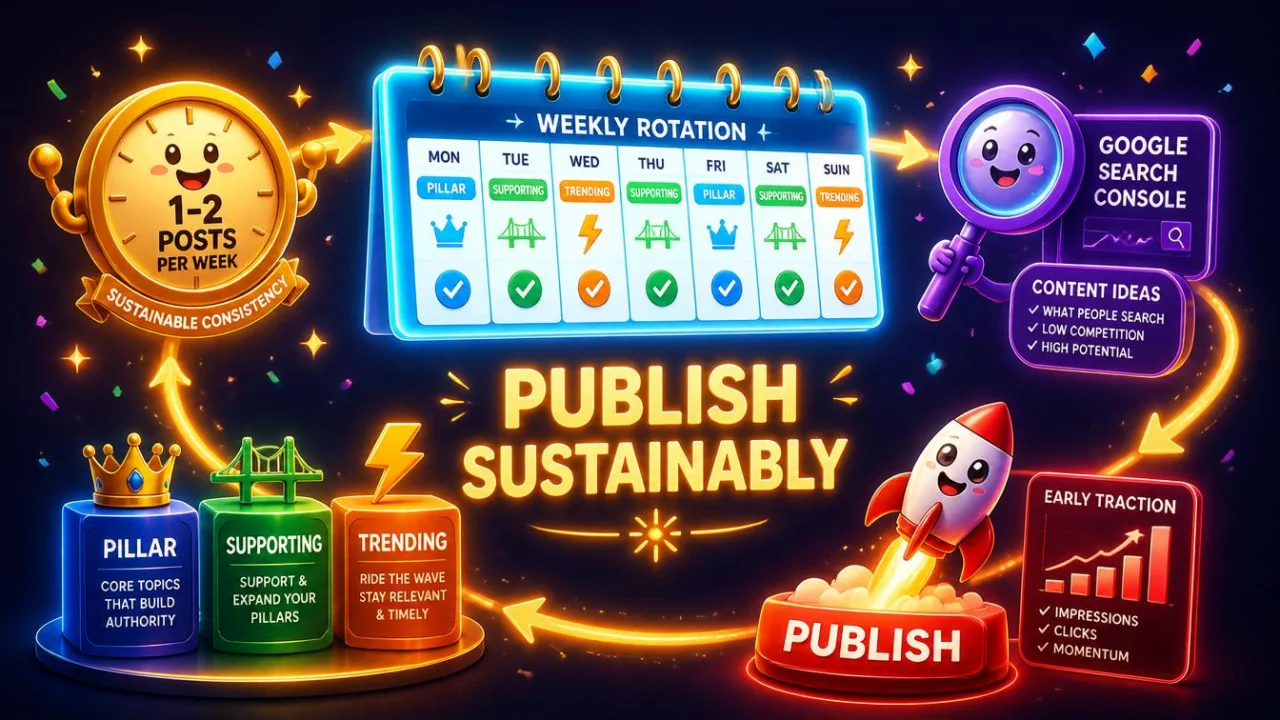
Before building your calendar, decide on a publishing frequency you can genuinely sustain for 6–12 months without burning out. For most solo creators and small teams, that's one to two posts per week.
Sustainable frequency always beats ambitious frequency that falls apart.
The Three-Pillar Content Structure
Organise your content calendar around three types of content, each serving a different purpose:
Pillar Content (20% of your publishing) These are your flagship articles — long, comprehensive guides targeting competitive, high-value keywords. "The Complete Guide to X." "Everything You Need to Know About Y." These take more time to produce but drive sustained organic traffic for months and years.
Publish one pillar piece per month. Link to it repeatedly from supporting content.
Supporting Content (60% of your publishing) These are focused articles that support your pillar pieces. They target long-tail keywords related to the pillar topic, rank more easily due to lower competition, and link back to the pillar to consolidate authority.
Example: Pillar is "The Complete Guide to Website Engagement." Supporting pieces are "What is Dwell Time?", "How to Reduce Bounce Rate", "Using Internal Links to Keep Visitors on Your Site."
Trending/Timely Content (20% of your publishing) Industry news, platform updates, seasonal topics. These don't have long-term search value, but they get shared, attract backlinks, and signal to Google that your site is current and active.
How to Find Content Ideas That Actually Rank
Google Search Console — Your best source of content ideas is already in your data. Look for queries where you're ranking in positions 11–30. You're appearing in search for these terms, but not yet on page one. A focused piece targeting these queries directly can move you onto page one relatively quickly.
Google's "People also ask" boxes — Type any topic into Google and look at the "People also ask" section. Every question is a potential blog post title. These questions represent actual search queries with genuine volume.
Reddit and Quora — Find subreddits and Quora spaces relevant to your niche. The most upvoted questions are telling you exactly what your audience wants answered — and often haven't been well covered yet.
The Content Calendar Template
Here's a simple monthly template that works:
Week 1: Supporting piece (long-tail topic A) Week 2: Trending/timely piece (industry news or update) Week 3: Supporting piece (long-tail topic B) Week 4: Pillar piece (major guide or comprehensive resource)
This rotation means you're always producing a mix of quick wins (timely content that gets shared), sustained ranking efforts (supporting content), and long-term authority builders (pillar content).
Getting Initial Traction on New Content
Every new article faces the cold-start problem: no engagement history for search engines to evaluate. Even well-optimised content can sit on page 3 for weeks before Google is confident enough to move it up.
Two ways to address this:
First, promote every new piece consistently across every channel you have — email list, social media, relevant communities. Real shares from real people are the strongest possible signal.
Second, platforms like LiveAdvertise can connect your new content with community members who visit and read for genuine session durations. This establishes early engagement data and gives search engines something to work with while organic rankings develop.
The calendar provides the consistency. The promotion strategy gives each piece its best chance from day one.