Paid-to-click (PTC) sites pay you small amounts to view advertisements. Some do pay. Others never will, and for the first week the two look almost the same.
How PTC works in one minute
Advertisers buy views, the site keeps most of the money, and members receive a small share for each ad they view. Many sites add referral programs and paid upgrades. Expect pennies. If you treat it as pocket money, you will not be disappointed; if you treat it as a job, you will be.
The checklist
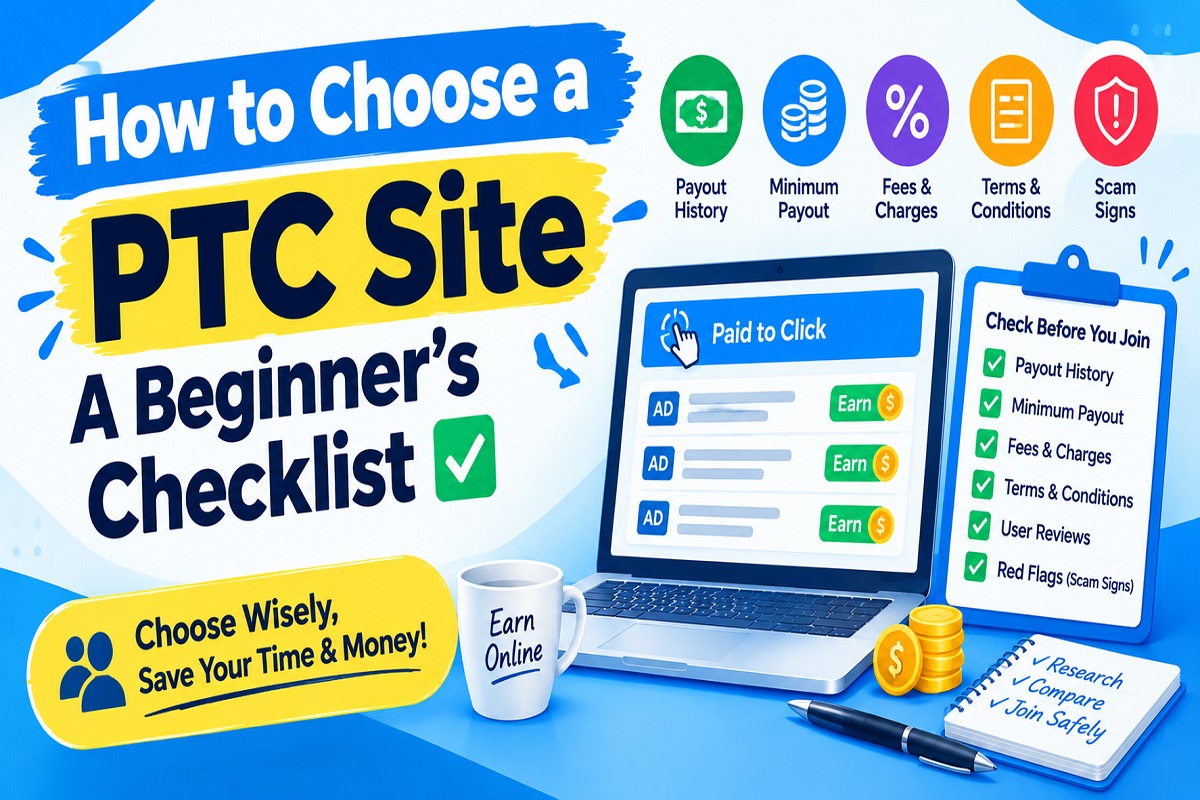
1. Proof of payment you can trust. Look for recent payouts reported by people who are not the site owner. Screenshots on the site’s own pages prove nothing.
2. How long until you can cash out. Divide the minimum payout by what you realistically earn per day. If the answer is months, the minimum is working as a lock.
3. Payout methods and fees. Check which methods are offered, whether they work in your country, and whether fees take a large bite out of small payouts.
4. Pressure to pay. If you cannot earn or withdraw without upgrading, that is not a free service. Be especially cautious of anything that talks about “investing” or “returns”.
5. Ad quality and volume. There should be enough ads to earn something, and none of them should force downloads, open endless pop-ups or ask for personal details.
6. Rules about accounts. Read the terms: usually one account per person, sometimes one per household or connection, with limits on VPN use. Breaking a rule you never read is how people lose balances.
7. Age and openness. How long has the site existed? Is there contact information, and does support answer? Sudden redesigns, new names and disappearing forum threads are all worth noticing.
8. A sane referral program. Referrals are fine as an extra. If earning anything meaningful requires recruiting people, step back.
Habits that keep you safe
- Use a separate email address for these sites.
- Never reuse a password.
- Do not upload ID documents to a site you have not tested.
- Start with the free membership only.
- Request a first small payout as early as you can. If it arrives, keep going. If it does not, you have lost almost nothing.
- Keep a simple note of time spent and amount earned so you can see what your hour is worth.
A fair expectation
Most people earn a few cents a day from PTC clicking alone. That is why a site’s payout history matters more than its design or its promises.
A simple seven-day test
Before you invest real time in a new site, give it one week.
- Day 1: Sign up with a free account, read the terms and count how many ads are available each day.
- Days 2 to 5: Click every day and write down what you earn and how long it takes.
- Day 6: Divide the minimum payout by your daily earnings to see how many days you would need.
- Day 7: Decide. If the minimum is reachable within a month or two, keep going and cash out as soon as you can. If it is not, move on and do not feel bad about it.
Warning signs that appear after you sign up
Some problems only show up later. Be careful if the minimum payout rises as your balance grows, if the terms change just before you reach the minimum, if your account is suspended for vague reasons close to a payout, or if support suddenly stops replying. Any one of these is a reason to pause. Several together mean you should not put in more time.
Is PTC worth your time?
That depends on what else you could do with the same minutes. If you click during spare moments and treat any payout as a bonus, it can be harmless. If you need steady income, look somewhere else. Knowing which group you belong to saves a lot of disappointment.
Looking for places to start? Compare the sites in our PTC & GPT Sites category. Listings with a green Verified badge carry our tracking pixel, so their rank reflects measured visitors, and sites without it are marked No pixel. We list sites but do not endorse them; always test with a small payout first.