The Psychology of Website Engagement: Why Visitors Leave (And What Keeps Them)
Let's be honest about something. Most website advice focuses on what to do — add internal links, write longer content, improve your title tags. But very few people ask the more important question: why do visitors actually leave?
Understanding the psychology behind bouncing changes everything about how you approach your website.
The Three-Second Rule
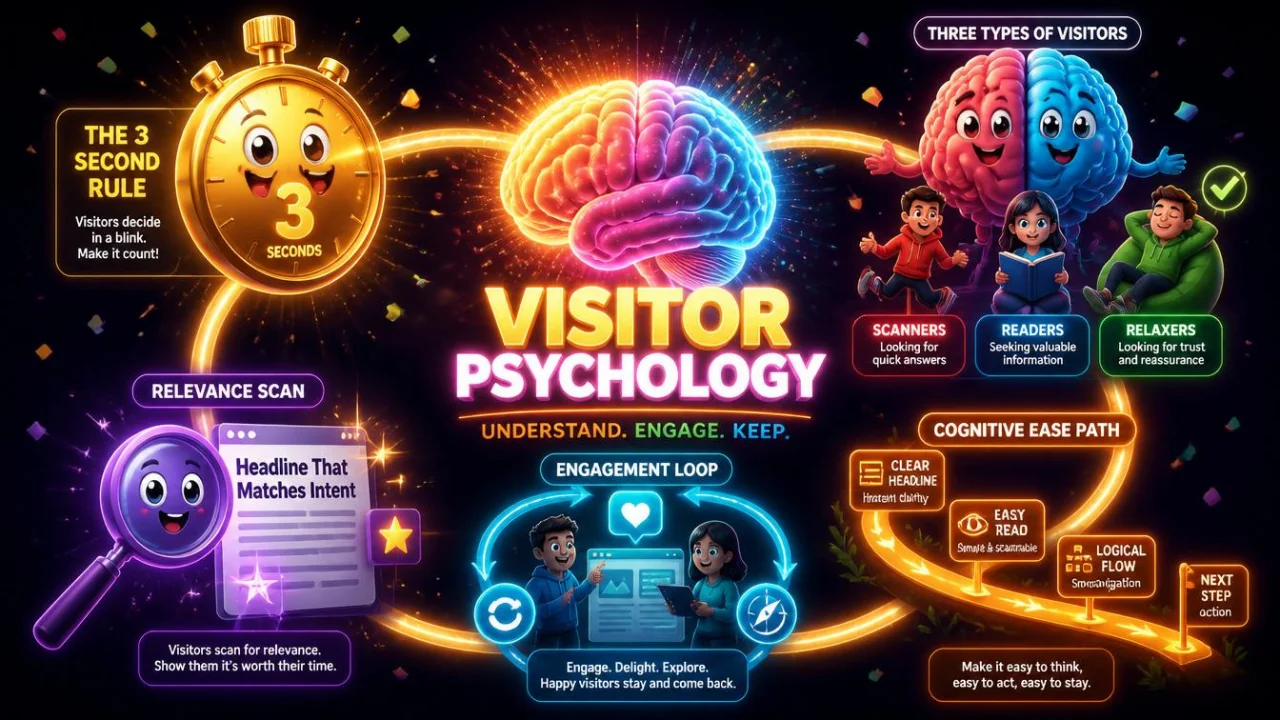
Visitors form their first impression of your website in approximately three seconds. Not three minutes. Three seconds. In that window, they're not reading your content — they're pattern-matching.
They're asking one question: "Is this what I was looking for?"
Their brain is scanning for signals: Does the headline match what I searched for? Does the design feel trustworthy? Is the content obviously relevant to my problem?
If the answer to any of these is "not sure" — they leave. Not because your content is bad. Because the pattern didn't match fast enough.
The Three Types of Bouncer
Not all bounces are equal. Understanding which type you're dealing with changes your fix:
The Instant Bouncer Leaves within 5–10 seconds. Usually caused by: page load speed, a headline that doesn't match their search, or a jarring design mismatch. Fix: faster loading, clearer headline alignment.
The Partial Reader Scrolls 30–40% of the page, then leaves. This visitor was interested but lost momentum. Usually caused by: a strong opening that doesn't maintain pace, lack of subheadings, or no clear next step mid-content. Fix: better content structure, strategic internal links, and a strong mid-page hook.
The Satisfied Leaver Read everything, got what they needed, left. This bounce doesn't hurt your rankings — it might help them. Time-on-page was high, scroll depth was strong. Google registers satisfaction, not abandonment.
The insight: Reduce the first two. Don't obsess over the third.
What Actually Keeps People Reading
Relevance above everything. Your opening paragraph must immediately confirm the visitor is in the right place. Don't warm up slowly. Don't start with a story about yourself. Start with the most useful thing on the page.
Cognitive ease. Heavy blocks of text are cognitively exhausting. Readers unconsciously resist them. Break your content with subheadings every 200–300 words. Use bullet points for lists. Use tables for comparisons. Make the reading experience feel effortless.
The promise of more. A well-placed internal link mid-content does two things: it tells the reader there's more valuable content nearby, and it gives them a reason to stay on your site rather than return to Google.
Real engagement from real people. One underappreciated factor in visitor engagement is social proof from actual visit behavior. When real people spend meaningful time on your pages, it creates engagement signals that both search engines and subsequent visitors respond to. Platforms like LiveAdvertise connect your content with a community of real users who actually read and explore — establishing genuine engagement baselines that content can then build on.
The Engagement Loop
The websites that retain visitors best have built an engagement loop:
- Strong opening that immediately confirms relevance
- Content that delivers on that opening promise
- Internal links that offer natural next steps
- A compelling reason to return (email list, regular publishing, etc.)
No individual tactic works in isolation. A brilliant piece of content with no internal links loses visitors at step three. A well-linked site with a weak opening loses them at step one.
Your Immediate Action List
Open Google Analytics right now. Find your three highest-traffic pages with the worst bounce rates. For each one, read the first 100 words honestly and ask: does this immediately confirm what a searcher would expect to find?
If the answer is no — rewrite the opening. That one change, done properly, moves the needle faster than almost anything else.